
Progress Is No Accident. It Is an Equation.
Why Europe hasn’t lost its engines, but its multiplier, and why that is the best news in a long time.
Our present moment feels like an ending. War, inflation, geopolitical upheaval, a technology that computes faster than we can think. The mood across Europe has turned defensive. We administer where we should be shaping.
Let me offer a different reading. What feels like an ending is, in truth, a transition. And transitions obey an equation.
The Progress Equation
For years I have described progress with a single equation — the Progress Equation:
Progress = (Talent + Capital) × (Trust + Friction)
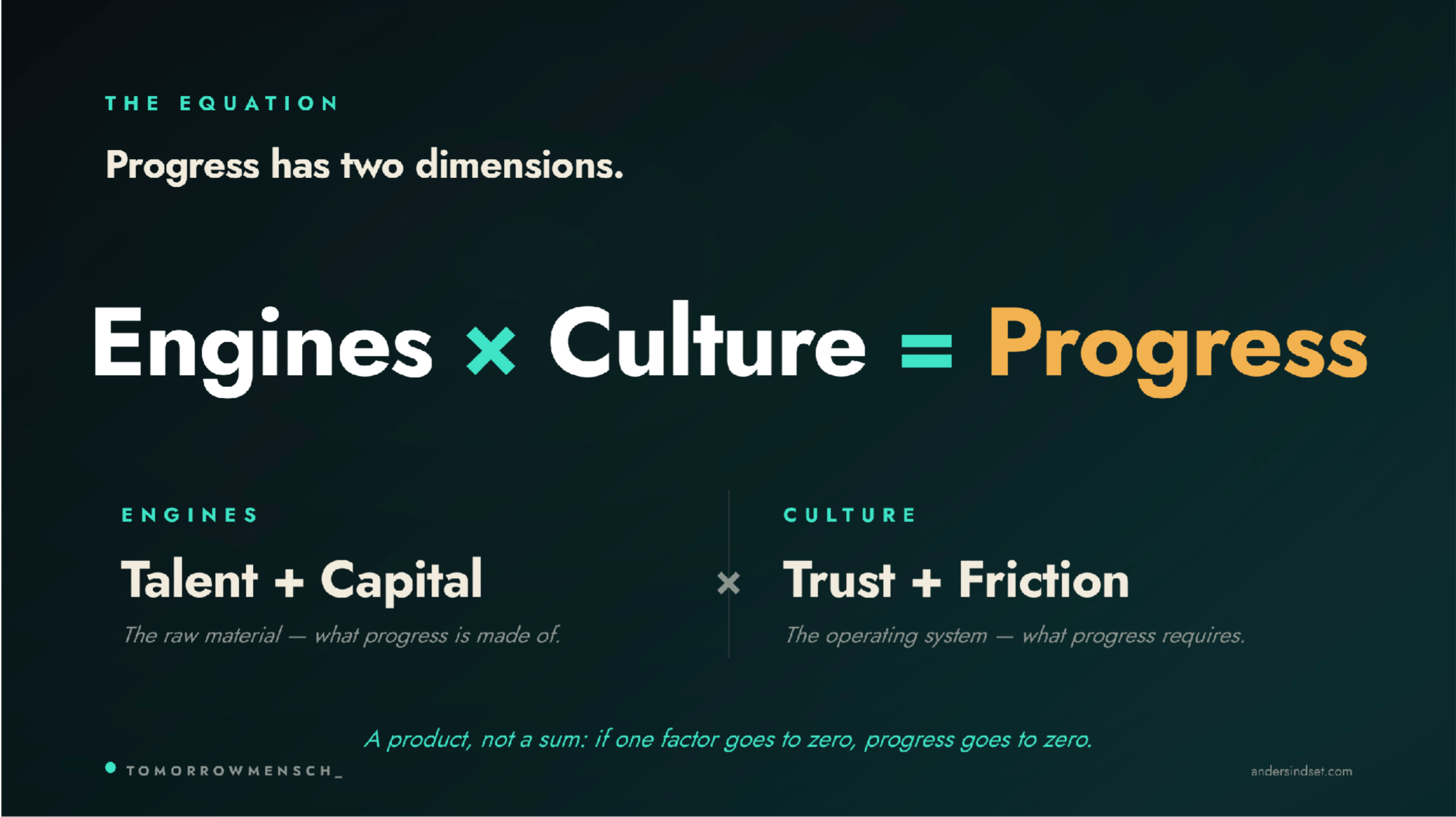
The left bracket holds the engines, the resources progress is made of: talent and capital (more precisely: free cash flow). The raw material.
The right bracket holds the culture, the conditions that allow progress in the first place: trust and friction. The operating system.
Talent without capital remains an idea.
Capital without talent remains money.
Trust without friction becomes stagnation.
Friction without trust becomes deadlock.
Within the brackets we add. Between them we multiply, and that is what matters. Progress is not a sum; it is a product. And a product has one unforgiving property: if a single factor approaches zero, the result approaches zero, no matter how large the other is. We can assemble the best talent and the most capital in the world, if the culture collapses, nothing happens.
The engines are not the problem
Here it gets interesting. Because we are not short of engines. We have talent, engineering, skilled work, research ecosystems the world envies. We have capital, companies of real substance, balance sheets that withstand crises, family firms that think in generations rather than quarters. The engines are world-class.
And still progress stalls. Not because the first factor is too small, but because the second, the culture, has come under pressure.
You can see it in the money itself. It is there, but it sits stuck: in savings, government bonds, concrete, in safety, not in the venture. While the frontier is financed in the US and China, Europe’s capital flows to where it risks nothing. A functioning capital market would steer it into the new; ours parks it in the existing. The numbers are stark: no European company worth more than 100 billion euros has been built from scratch in fifty years, while all six US firms above a trillion were, every one of them venture-backed (Draghi). That is not an engine problem. It is a culture problem. And that brings us to the core.
Friction: we confuse two kinds
Friction has a fixed place in the equation. But we confuse two fundamentally different kinds.
There is blocking friction: bureaucracy, permitting gridlock, the reflexive “yes, but.” This friction binds energy without setting anything in motion. We have too much of it.
And there is productive friction: the honest argument over the best solution, the courage to take a risk, the contradiction that sharpens an idea. This friction releases energy. It drives. We have too little of it.
Trust: the second cultural factor
Friction alone is not enough. What decides whether friction brakes or drives is trust.
Without trust, every bit of friction becomes a blockade. Those who do not trust the other, the institution, the technology, hedge, collect another signature, add another caveat. With trust, the same friction turns productive: you may disagree without losing. You may dare without risking everything. You may fail without being finished. Trust is not the opposite of friction, it is the condition under which friction creates anything at all.
And precisely this trust has eroded, on four levels.
We distrust our institutions. We expect protection from the state, not departure; we want it to shield us, not to expect something of us.
We distrust technology. Before every new possibility stands the question of what could go wrong, long before we have asked what could go right. We regulate the new before we have understood it.
We distrust one another. Stuck capital is nothing other than congealed mistrust: money that flees into safety instead of the venture is money that no longer trusts anyone to make something of it.
And deepest of all: we distrust ourselves. A society that once built the future and exported it to the world now asks first what it cannot do. This loss of self-trust is the most expensive of all, because it multiplies into everything else.
That is the whole diagnosis. Not: “we lack ability.” But: “we don’t let our ability work.” We brake with the wrong friction, and skimp on the trust that makes the right kind possible.
What is actually happening
And while we are preoccupied with ourselves, something is dissolving that has defined economics since its beginning: scarcity.
Intelligence. The cost of a comparable AI query has fallen roughly 280-fold in about eighteen months (Stanford AI Index). Knowledge, and increasingly thinking itself, is becoming infrastructure.
Energy. Solar power has become about 90 percent cheaper in a decade; negative electricity prices are already reality (Lazard, IEA). The foundational resource of our economy is losing its scarcity.
Life. The first cultivated burger cost around 250,000 euros in 2013, a decade later it is approved and orders of magnitude cheaper. Reading a human genome cost a billion dollars in 2003; today it costs less than a thousand, a millionfold collapse, faster than Moore’s Law (NHGRI). The same learning curve that made solar and AI cheap is now reaching biology. We are hacking biology and chemistry; the code of life is becoming readable and writable, life is moving from something we observe to something we shape.
This is a shift of historic scale, and it only feels like an ending because an old order is leaving before the new one has arrived. In the in-between lives anxiety. But in the in-between also lives opportunity.
The decisive capability of our time is therefore no longer prediction. It is perception. Those who move forward are not the ones who forecast the future most precisely, but the ones who perceive earlier what is dissolving, and act on it. I call this Anticipatory Leadership.
A call to act
Europe has the engines, talent and capital in abundance. The first factor is not what’s missing. But in every multiplication, two factors decide the outcome; if one of them is zero, the other becomes meaningless. And precisely this second factor is what we lack right now: the will to act.
We must dismantle the blocking friction and allow the productive kind. We must win back trust, including trust in our own capacity to shape. We must stop administering the future and start to future it.
This is where what becomes possible is decided. It is a question of stance. And stance is a decision. I call this Possibilism: the mere fact that we can still ask the question “Which future is worth wanting?” is proof that the answer is still open. Future-anxiety is perception without agency. An appetite for the future is perception with agency.
We have everything the equation demands. We only need to multiply again.